Norway Office

Contact us for Ahraz head office information.

info@ahraz.org

You can write to us for all your questions and other issues.

+46766867343

You can call us for all your questions and other issues.

Association for the Human Rights of the Azerbaijani People in Iran

Ahraz Blog

Autem vel eum iriure dolor in hendrerit in vulputate velit esse molestie consequat, vel illum dolore eu feugiat nulla facilisis at vero eros et dolore feugait.

Report on the death penalty in Azerbaijan’s cities in Iran (2015-2016)

Report on the death penalty in Azerbaijan’s cities in Iran (2015-2016)

From October 2015 to October 2016, totally 588 people were sentenced to death in Iran. Out of this number, 504 people were hanged and executed in this country. During this period, 187 people were hanged in the mostly Azerbaijani  Turkish  populated provinces such as West Azerbaijan (comprising 10% of the executed in this period), East Azerbaijan (8%), Ardabil (7%), Zanjan (4%), Qazvin (6%), and Hamadan (2%).

57% of the executed were accused of crimes related to drugs, 26% in relation to murder because of adultery, 7% related to political and security reasons, and 4 % other cases.

39% of the executions in this period were reported by the Iranian domestic and official media and 61% were reported by non-governmental and independent media and institutions.

From January-March 2017, 34 people were hanged in the Azerbaijani populated cities in Iran such as Tabriz, Urmia, Ardabil, Zanjan, Qazvin, Maraghe and Maku, who were accused of the crimes related to drugs and murder. Some of the details related to these cases in this short period are mentioned below, as example:

  • A prisoner, called Rashid Javadi from Jolfa city was hanged in the Tabriz Central Prison on 7 January 2017 because of holding and carrying 106 grams of heroin.
  • Morteza Heydari from Malekan (East Azerbaijan Province) who was accused of positioning 3 kilos industrial drugs and 3.6 kilos of heroin was hanged in the Maraghe Prison in January 2017. At the time of reporting, four other prisoners are to be hanged soon in this prison. These people include: Iraj Ghafouri from Khoy City, accused of crimes in relation to drugs, Akbar Moradi from Maraghe City because of murder, Hoseyn Fatemi from Miandoab (Qoshachay) City as well as Ali Mostofi from Maraghe City.
  • On 18 January 2017, three prisoners accused of holding drugs as wells as a child accused of murder at the time of adolescence were executed in the Tabriz Central Prison. These prisoners included Parviz Solati, Qorban Lotfi, Ertekan Karimi, and Hasan Hasan Zadeh, 18 years old who committed murder at the time of 15 years old.
  • A handicapped prisoner, named Qabl Ali Babir who had missed his two legs as well as another prisoner called Sina Hoseyn Pour, both accused of holding drugs, were hanged in the Urmia Central Prison on 21 January 2017.
  • Hashem Qaraqozlu from Qorveh, accused of holding drugs, was hanged in the Hamadan Central Prison on 29 January 2017.
  • Taher Saeidi, accused of holding drugs, was hanged in Maku Prison on 01 February 2017.
  • Kuchak Naji, accused of crimes related to drugs, was hanged in the Urmia Central Prison, on 03 March 2017.
  • Morad Seyfi from Miandoab (Qoshachay) City, and Mr. Morad Payiz from Maraghe City both accused of crimes related to drugs, were hanged in Maraghe Prison on 05 March 2017.
  • Four prisoners, accused of crimes related to drugs, were hanged in the Urmia Central Prions on 14 March 2017. These included Changiz Baduzadeh, Akram Hoseyn Pour from Salmas City, Vahed Hamedi from Ardabil City and Kiomars Fridan (nicknamed Delavar) from Urmia City.

Joint Ngo Letter In Support Of Human Rights Council 34th Resolution On Human Rights In Iran

To: Permanent representatives of member states of the Human Rights Council

Your Excellency,

 We, the undersigned cross-regional group of human rights civil society organizations call on your government to support the resolution renewing the mandate of the Special Rapporteur on the situation of human rights in the Islamic Republic of Iran at the 34th session of the United Nations Human Rights Council. The country mandate has been a vital tool of promotion human rights in Iran since its establishment in 2011. It has proven effective at spotlighting the gravity of the situation in the country and provoking internal debate about some laws and practices that violate international human rights law and standards. Only through continued attention from the international community will these initial achievements translate into measurable reforms of law and practice that substantively improve the rights situation people in Iran face.

Despite diplomatic and trade openings since the implementation of the internationally agreed Joint Comprehensive Plan of Action on Iran’s nuclear programme, hopes that human rights improvements would follow have not yet materialized. Core issues of concern outlined by UN treaty bodies, special procedures and the UN Secretary-General remain unaddressed. Iran has failed to co-operate with special procedures, and despite issuing a standing invitation to all Special Rapporteurs in 2002, it has allowed no country visits since 2005. Accordingly, it is essential that the Human Rights Council continues to treat human rights in Iran as a priority concern. Moreover, as Iran has a newly elected parliament, and an upcoming presidential election in May 2017 this is a crucial time for the international community to emphasize its concerns to the government.

Iran has maintained the highest per capita execution rate in the world for several years and, according to the Special Rapporteur, put to death at least 530 people in 2016. In January 2017 alone, the authorities executed at least 72 people. The majority of these executions took place after unfair trials and were for drug-related offences, which do not meet the threshold of the “most serious crimes” to which the use of the death penalty must be restricted under international law. Some others were executed for vaguely worded offences such as “enmity against God”. Under Iranian law, activities that should not be criminalized at all, such as adultery, consensual same-sex sexual conduct and “insulting the Prophet”, remain punishable by death. In 2016, there were reports of at least two men being sentenced to death for “insulting the Prophet”. Iran continues to execute individuals who were under the age of 18 at the time of the crime. In the last two years, authorities executed at least nine juvenile offenders, including at least two in January 2017.

Torture and other ill-treatment of detainees remains common, especially during interrogation. The authorities systematically failed to investigate allegations of torture and other ill-treatment and judges continue to use “confessions” obtained as a result of torture to convict defendants. Authorities frequently deny access to adequate medical care for political prisoners, in many cases as an intentional means of punishing them. Judicial authorities also continue to impose and carry out flogging, blinding, and amputation.

The Iranian authorities severely restrict the exercise of freedom of expression, association, and peaceful assembly. These restrictions include pervasive censorship of the press and internet, the criminalization of many forms of speech, arbitrary restrictions on civil society, and persecution for acts of religious worship by certain religious minorities. The authorities routinely use arbitrary detention to stifle and punish dissent. Those targeted include journalists, lawyers, political activists, student activists, trade unionists, artists, bloggers, and human rights defenders including women’s rights defenders, and LGBT rights activists who have simply been exercising rights protected under international law.  In the past year, under the guise of national security offences, courts imposed increasingly harsh prison sentences on these individuals for peaceful acts such as criticism of Iran’s human rights record on social media, communication with international human rights mechanisms, or organizing petitions.

Ethnic minority activists, including Arabs, Balochs, Kurds and Azerbaijani Turks, and members of religious minorities, such as Baha’is, Protestant Christians including Christian converts, Sunni Muslims, Sufi Muslims and the Yarasan, also face similar patterns of abuse and restriction of their rights. They remain subject to entrenched discrimination that includes limits on their access to education, employment, adequate housing, political office, and the exercise of other cultural, civil and political rights.

Systematic discrimination and violence against women and girls in law and practice merit serious concern. Women, for example, do not have equal rights with men in marriage, divorce, child custody, inheritance, watching several live sporting events in stadiums, and protection from criminal harm. Married women cannot obtain a passport without the permission of their husband. Moreover, a husband can prevent his spouse pursuing an occupation he deems against family values or harmful to his or her reputation. The legal age of marriage for girls is 13 and fathers can apply for permission to arrange for their daughters to be married at an even younger age.

The authorities have consistently failed to adopt laws criminalizing sexual and other gender-based violence, including early and forced marriage, marital rape and domestic violence. Compulsory “veiling” (hijab) laws empower police and other security forces to target women for harassment, violence, and imprisonment, and to deny women equal enjoyment of their economic and social rights, including to education, employment and sports.

Since 2014, the Iranian Parliament has debated eight bills, passing five, that further curtail women’s rights by limiting access to health and family planning services and employment.

In the past six years, the Special Rapporteur’s actions have helped to trigger calls for reforms from inside the country, particularly with respect to the use of the death penalty for drug offences. The Special Rapporteur has also provided crucial support for the work and protection of Iranian human rights defenders and, in a number of cases, improvements in the treatment of individual detainees.

Renewal of the Special Rapporteur’s mandate will send a powerful signal to the Iranian authorities that human rights violations and lack of accountability remain of concern, globally and for the Council, and that the international community expects meaningful and tangible improvements in that matter.

Sincerely,

Roya Boroumand, Executive Director

Abdorrahman Boroumand Foundation

Robin Phillips, Executive Director

The Advocates for Human Rights

Hassan Nayeb Hashem, Representative to the Human Rights Council

All Human Rights for All in Iran

Philip Luther, Research and Advocacy Director for the Middle East and North Africa

Amnesty International

Kamran Ashtary, Executive Director

Arseh Sevom

Mansour Borji, Advocacy Director

Article 18

Thomas Hughes, Executive Director

ARTICLE 19

Shahin Helali Khyavi, Director

Association for Human Rights of the Azerbaijani People in Iran

Taimoor Aliassi, UN Representative

Association pour les Droits Humains au Kurdistan d’Iran-Genève (KMMK-G)

Mansoor Bibak, Co-Director

Balochistan Human Rights Group

Simin Fahandej, Representative to the United Nations
Bahá’í International Community 

Jeremie Smith Director, Geneva Office

Cairo Institute for Human Rights Studies (CIHRS) 

Hadi Ghaemi, Executive Director

Center for Human Rights in Iran (formerly the International Campaign for Human Rights in Iran)

Dr. Shirin Ebadi, Founder and President

Center for Supporters of Human Rights

Veronica Yates, Director
Child Rights International Network  (CRIN)

Renate Bloem, Main Representative to the United Nations in Geneva

CIVICUS

Courtney Radsch, Advocacy Director.

Committee to Protect Journalists

 Juana Kweitel, Executive Director

Conectas Direitos Humanos

 Clementine de Montjoye, Advocacy and Research Officer
East and Horn of Africa Human Rights Defenders Project

 Raphaël Chenuil-Hazan, Executive Director

Ensemble Contre La Peine de Mort (ECPM)

 Ibrahim Al Arabi, Executive Director

European Ahwazi Human Rights Organisation

 Ann Hannah, Director of Policy and Advocacy

Freedom From Torture

 Khalid IBRAHIM, Co-Director

Gulf Center for Human Rights (GCHR)

Keyvan Rafiee, Director

Human Rights Activists in Iran

Sarah Leah Whitson, Director of the Middle East and North Africa Division

Human Rights Watch

 Mani Mostofi, Director

Impact Iran

André du Plessis, Headead of UN Programme and Advocacy

The International Lesbian, Gay, Bisexual, Trans and Intersex Association (ILGA)

Taisuke  Komatsu, UN Advocacy Coordinator and Under Secretary-General

International Movement Against All Forms of Discrimination and Racism

Phil Lynch, Director

International Service for Human Rights

Saghi Ghahraman, President

Iranian Queer Organization (IRQO)

Mahmood Amiry-Moghaddam, Executive Director

Iran Human Rights

Rob Testo, Executive Director
Iran Human Rights Documentation Center

Shadi Sadr, co-director

Justice for Iran

Rebin Rahmani, European Director

The Kurdistan Human Rights Network

Mark Lattimer, Executive Director

Minority Rights Group International

Jessica Stern, Executive Director

OutRight Action International

Mehrangiz Kar, Chairperson

Siamak Pourzand Foundation

Mahmood Enayat, Director

Small Media

Firuzeh Mahmoudi, Executive Director

United for Iran

Elizabeth A. Zitrin, President

World Coalition Against the Death Penalty

Shadi Amin

6Rang: Iranian Lesbian and Transgender Network


Iran: Repression of those seeking truth and justice for 1980s killings needs to stop

8 March 2017

Iran: Repression of those seeking truth and justice for 1980s killings needs to stop 

The Iranian authorities should stop the harassment, intimidation and prosecution of human rights defenders seeking truth and justice on behalf of individuals who were summarily executed or forcibly disappeared during the 1980s and their families, said 20 human rights groups.

Over the past few months, several human rights defenders, including Mansoureh Behkish, Maryam Akbari-Monfared and Raheleh Rahemipour, have been subjected to harassment, reprisals or prosecution on vague national security-related charges for their peaceful efforts to learn the fate and whereabouts of their loved ones. The persecution signals renewed efforts by the authorities to suppress the struggle that has been ongoing for over three decades to reveal the truth about the gross human rights violations that were perpetrated by the Iranian authorities during the 1980s, including the extrajudicial executions of several thousands in 1988 and their burial in unmarked mass graves.

The latest wave of persecution of those seeking truth and justice appears to have been triggered by the release in August 2016 of an audio recording of a meeting in 1988 in which senior officials are heard discussing and defending the details of their plans to carry out the 1988 mass executions.

The audio recording has sent shockwaves across the country and prompted the authorities to admit for the first time that the mass killings of 1988 were planned at the highest levels of government. Ahmad Montazeri, the son of the late Ayatollah Hossein Ali Montazeri, who was at that time the Deputy Supreme Leader, has since been sentenced to imprisonment for posting the audio file on his father’s website.

The undersigned human rights organizations are deeply concerned about these developments and call on the Iranian authorities to quash the convictions and sentences issued against Maryam Akbari-Monfared, Raheleh Rahemipour and Ahmad Montazeri; close the criminal case opened against Mansoureh Behkish; and immediately and unconditionally release Maryam Akbari-Monfared. The authorities should also ensure a safe and enabling environment in which it is possible for human rights defenders, including family members, to seek information about the mass killings, express themselves without any fear of persecution, and defend the rights to truth, justice and reparation, as a first step to ending impunity in Iran.

The undersigned human rights organizations urge the Iranian authorities to stop their attempts to silence human rights defenders and others seeking to shed light on past atrocities. Instead, they should respect their obligations under international human rights law to carry out thorough and impartial investigations into the serious human rights violations committed in the 1980s, including the 1988 extrajudicial executions, and ensure the rights to truth, justice and reparations for the victims and their families.

Cases of individuals targeted

Individuals who have been targeted in recent months for seeking truth and justice include human rights defenders Mansoureh Behkish, Maryam Akbari-Monfared and Raheleh Rahemipour, and the son of the late Ayatollah Hossein Ali Montazeri, Ahmad Montazeri.

Mansoureh Behkish was informed on 29 October 2016 that she had been charged with “gathering and colluding to commit crimes against national security” and “spreading propaganda against the system”. The charges stem solely from her peaceful human rights work to seek truth and justice, including her work with the Mothers and Families of Khavaran, a group comprised of mothers and other family members of political prisoners summarily executed during the 1980s, and from holding commemorative gatherings at her home and going with other families to Khavaran, a deserted mass gravesite in the south of Tehran where Iranian authorities buried some of the thousands of political prisoners extrajudicially executed in the 1980s, including Mansoureh Behkish’s sister, four brothers and brother-in-law.

Maryam Akbari-Monfared has faced reprisals since October 2016, when she filed a formal complaint from inside prison requesting an official investigation into the mass executions of political prisoners in the 1980s, including her brother and sister; the location of the graves where their bodies were buried; and the identity of the perpetrators involved. Officials have cancelled her medical care arrangements for her rheumatoid arthritis and thyroid problems and restricted visits from her family, including her three children, in retaliation. The prosecution authorities have also threatened her with new charges. According to her family, the Associate Prosecutor of Evin prison has said: “What does she want to know? Those who executed her brothers and sister have either died or become elderly and her brothers and sister are probably buried in Khavaran… Such complaints are of no use. They would only make her conditions in prison more difficult and impede her release or access to [prison] leave.”

Maryam Akbari-Monfared is serving a 15-year sentence in Tehran’s Evin prison on several charges, including “enmity against God” (moharebeh), after a May 2010 sentencing. Amnesty International’s research indicates that her conviction was based on the fact that she had made several phone calls to her siblings, who are members of the banned opposition group known as the People’s Mojahedin Organization of Iran (PMOI), and had once visited them near the PMOI-run Camp Ashraf in Iraq. She has consistently denied her alleged membership in the PMOI. She was never provided with a written judgement, setting out the evidence and legal reasoning relied upon to convict her. Her husband has said that during her trial session, the judge told her “she was paying for the activities of her brother and sister with the PMOI”. Her appeals were dismissed in a summary fashion with no reasons provided. Her request for judicial review is currently pending before Iran’s Supreme Court.

Raheleh Rahemipour was sentenced to one year’s imprisonment in January 2017 after Branch 15 of the Revolutionary Court in Tehran convicted her of “spreading propaganda against the system” for her peaceful efforts to learn the truth about the whereabouts of her brother Hossein Rahemipour, who was summarily executed in 1984, and his baby daughter Golrou Rahemipour, who was forcibly disappeared 15 days after she was born in Evin prison. The prison authorities took the baby away, ostensibly for medical tests, but never returned her to her mother. The family was subsequently told that baby Golrou Rahemipour had died, but the authorities never provided a death certificate, information about her death, or where she had been buried.

The court verdict issued against Raheleh Rahemipour cites her media interviews, her participation in peaceful gatherings while holding a sign that read “You killed my brother! What did you do to his daughter?”, and her signature on a petition in support of demands for truth and justice for those summarily executed as “evidence” of acting against national security. In May 2016, the UN Working Group on Enforced or Involuntary Disappearances sent a communication to the Iranian authorities with regard to the case of Raheleh Rahemipour’s brother and niece. The authorities had not responded by the end of February 2017. Raheleh Rahemipour remains at liberty, awaiting the outcome of her appeal.

Ahmad Montazeri, the son of the late Ayatollah Hossein Ali Montazeri, was sentenced to 21 years’ imprisonment in November 2016 after the Special Court of Clergy convicted him of several charges including “spreading propaganda against the system” and “revealing plans, secrets or decisions regarding the state’s domestic or foreign policies…  in a manner amounting to espionage”. The court ruled that in light of Ahmad Montazeri’s family history and lack of a criminal record, he only needs to serve six years of the sentence. Ahmad Montazeri’s conviction stems from the publication of the audio file on his father’s website, which the authorities said advanced the interests of the enemies of the Islamic Revolution, and the media interviews that he subsequently gave to media outlets based outside Iran. Ahmad Montazeri was imprisoned on 22 February 2017 to begin serving his sentence, but was granted temporary prison leave the next day. He was informed several days later that his prison sentence had been suspended.

Background

Ayatollah Hossein Ali Montazeri was once in line to become the late Supreme Leader Ayatollah Ruhollah Khomeini’s successor but he lost his status after he voiced strong opposition to the 1988 mass killings. In the audio file released by his son in August 2016, Ayatollah Hossein Ali Montazeri is heard saying: “The greatest crime committed in the Islamic Republic, for which history will condemn us, has been committed at your hands and, in the future, your names will go down in history as criminals.”

Under international law, individuals against whom there is evidence of criminal responsibility for serious international crimes, including those with command responsibility, should be prosecuted and tried before a court established by law and with all necessary procedural guarantees, in accordance with international fair trial standards.

If found guilty, they should be punished with appropriate penalties, which take into account the grave nature of the crimes but which do not include the death penalty or corporal punishments.

Signatories:

  1. Abdorrahman Boroumand Foundation
  2. All Human Rights for All in Iran
  3. Amnesty International
  4. Article 19
  5. Association des Chercheurs Iraniens – ACI
  6. Association for the Human Rights of Azerbaijani People in Iran(AHRAZ)
  7. Association of Human Rights in Kurdistan of Iran-Geneva – KMMK-G
  8. Front Line Defenders
  9. Human Rights Activists in Iran
  10. Human Rights Watch
  11. Insight Iran
  12. International Campaign for Human Rights in Iran
  13. Iran Human Rights
  14. Justice for Iran
  15. Kurdistan Human Rights Network
  16. Small Media
  17. The Baloch Activists Campaign
  18. United4Iran
  19. Universal Tolerance
  20. Women Living Under Muslim Laws (WLUML)

Joint Ngo Letter In Support Of 2016 Unga Resolution On Hr In Iran

To: Member States of the United Nations General Assembly

Your Excellency:

We, the undersigned human rights organizations, welcome the decision of the 71st session of the United Nations General Assembly’s Third Committee to pass Resolution A/C.3/71/L.25 on the promotion and protection of human rights in the Islamic Republic of Iran. The resolution sends a vital message to all governments and the people of Iran that the human rights situation in the country is of international concern and that reforms are urgently needed.

We hope to see increased support for the resolution when it comes up for a vote again at the United Nations General Assembly (UNGA) plenary session and we encourage all member states to vote in favor of it.

Despite recent diplomatic and trade openings that have occurred since the implementation of the Joint Comprehensive Plan of Action, human rights should continue to be a top concern in Iran and for those states seeking expanded diplomatic and economic ties to Iran. The situation in the country remains dire and has deteriorated in several areas. As the government pursues deeper international ties, this is a uniquely opportune time to push for significant improvements in the human rights situation in Iran.

Moreover, as Iran has a newly elected parliament, and an upcoming presidential election in May 2017, this is a crucial moment for the international community to outline its concerns to the government. To that end, while the text of this year’s resolution welcomes recent positive steps taken by the government, it also raises the most urgent rights issues in the country.

Iran has maintained the highest per capita execution rate in the world for several years, putting to death over 500 people so far in 2016. The majority of these executions take place after unfair trials and are for crimes that do not constitute the “most serious crimes” under international law, such as drug-related offenses. Executions in Iran have included the execution of child offenders, including at least nine in the last two years; public executions; and the execution of individuals on vaguely worded offenses, such as “enmity against God” (moharebeh).

On 2 August 2016, authorities hanged 25 Sunni men, of whom 22 were from Iran’s Kurdish minority and three were Iraqi nationals, on charges of moharebeh. The Iranian authorities have only announced the execution of 20 men on that date. Our organizations and others observed that all these men had been convicted in proceedings marked by appalling examples of human rights violations, including the use of torture and other ill-treatment; admitting as evidence the use of forced “confessions”; and denial of access to a lawyer throughout the investigation stage. One of these men, all of whom were executed for alleged connections to armed activities, was Shahram Ahmadi, who maintained he had been tortured repeatedly by his interrogators during pre-trial detention which lasted almost three years. He also maintained that he had only been involved in non-violent religious activities.

The Iranian government continues to harshly restrict the peaceful exercise of freedom of expression, association, and assembly. These restrictions include widespread censorship of the press and Internet, the criminalization of peaceful dissent and protests, arbitrary restrictions on civil society, a ban on independent labor activities, and persecution for certain acts of religious worship. The Iranian authorities rely on the systematic use of arbitrary detention against journalists, lawyers, human rights defenders, political activists, student activists, artists and bloggers for exercising their protected rights. Ethnic minority activists, including Arabs, Baloch, Kurds and Azerbaijani Turks, and members of minority religions, such as Baha’is, Christian converts, Sunni Muslims, Sufi Muslims and the Yarasan, also face similar patterns of abuse and restriction of their rights.

On 26 November 2016, the Special Court for the Clergy in Qom, which is under the direct authority of Supreme Leader Ali Khamenei, issued a six-year prison sentence against Ahmad Montazeri. Montazeri was charged after posting on his official website an audio file of his deceased father, Grand Ayatollah Hosseinali Montazeri, the former Deputy Supreme Leader and one of Iran’s most prominent Shia Muslim clerics, harshly criticizing Iranian authorities’ mass execution of political prisoners in the 1980s.

Over the past two years, authorities have arrested numerous Iranian dual nationals, accusing them of participating in a “western-led” project to “infiltrate” the country and its core values. Authorities have also prosecuted several journalists, accusing them of being part of an “infiltration network,” offering as evidence any real or perceived association with individuals abroad, including family members living outside of Iran, as support for these allegations.

Systematic discrimination and violence against women in law and practice also merits serious concern. Married women, for instance, cannot obtain a passport without the permission of their husband. Moreover, a husband can prevent his spouse obtaining an occupation he deems against family values or harmful to his or her reputation. While women occupy about half of all university student slots, their economic participation in Iran is five times lower than men, according to government figures.

Since 2014, the Iranian Parliament has debated eight bills, passing four, that further curtail women’s rights by limiting access to health and family planning services, employment, or undermining protections against gender-based violence. For example one pending bill, the Bill to Increase Fertility Rates and Prevent Population Decline, curbs access to contraception and information about family planning, cuts government family planning programs, and outlaws surgical contraception. The Comprehensive Population and Family Excellence Bill, which is still before the Parliament, mandates employment discrimination against women and unmarried persons, makes divorce more difficult, and discourages police and judicial intervention in family conflicts.

We call on all UN member states to vote in support of Resolution A/C.3/71/L.25 on the situation of human rights in Iran at the UNGA plenary session. Passage of the Resolution will convey to all governments as well as the people of Iran that the international community is genuinely invested in human rights advancement in Iran.

Sincerely,

Roya Boroumand, Executive Director

Abdorrahman Boroumand Foundation

Robin Phillips, Executive Director

The Advocates for Human Rights

Hassan Nayeb Hashem, Representative to the Human Rights Council

All Human Rights for All in Iran

Philip Luther, Research and Advocacy Director for the Middle East and North Africa

Amnesty International

Kamran Ashtary, Executive Director

Arseh Sevom

Mansour Borji, Advocacy Director

Article 18

Thomas Hughes, Executive Director

ARTICLE 19

Shahin Helali Khyavi, Director

Association for Human Rights of the Azerbaijani People in Iran

Taimoor Aliassi, UN Representative

Association pour les Droits Humains au Kurdistan d’Iran-Genève (KMMK-G)

Mansoor Bibak, Co-Director

Balochistan Human Rights Group

Dr. Shirin Ebadi, Founder and President

Center for Supporters of Human Rights

Joel Simon, Executive Director

Committee to Protect Journalists

Jessica Morris, Executive Director

Conectas Direitos Humanos

Raphaël Chenuil-Hazan, Executive Director

Ensemble Contre La Peine de Mort (ECPM)

Ibrahim Al Arabi, Executive Director

European Ahwazi Human Rights Organisation

Ann Hanna, Head of International Advocacy

Freedom From Torture

Keyvan Rafiee, Executive Director

Human Rights Activists in Iran

Sarah Leah Whitson, Director of the Middle East and North Africa Division

Human Rights Watch

Mani Mostofi, Director

Impact Iran

Hadi Ghaemi, Executive Director

International Campaign for Human Rights in Iran

Stéphanie David, Representative to the United Nations in New York

International Federation for Human Rights (FIDH)

Phil Lynch, Director

International Service for Human Rights

Saghi Ghahraman, President

Iranian Queer Organization (IRQO)

Mahmood Amiry-Moghaddam, Executive Director

Iran Human Rights

Rebin Rahmani, European Director

The Kurdistan Human Rights Network

Mehrangiz Kar, Chairperson

Siamak Pourzand Foundation

Mahmood Enayat, Director

Small Media

Firuzeh Mahmoudi, Executive Director

United for Iran

Elizabeth A. Zitrin, President

World Coalition Against the Death Penalty


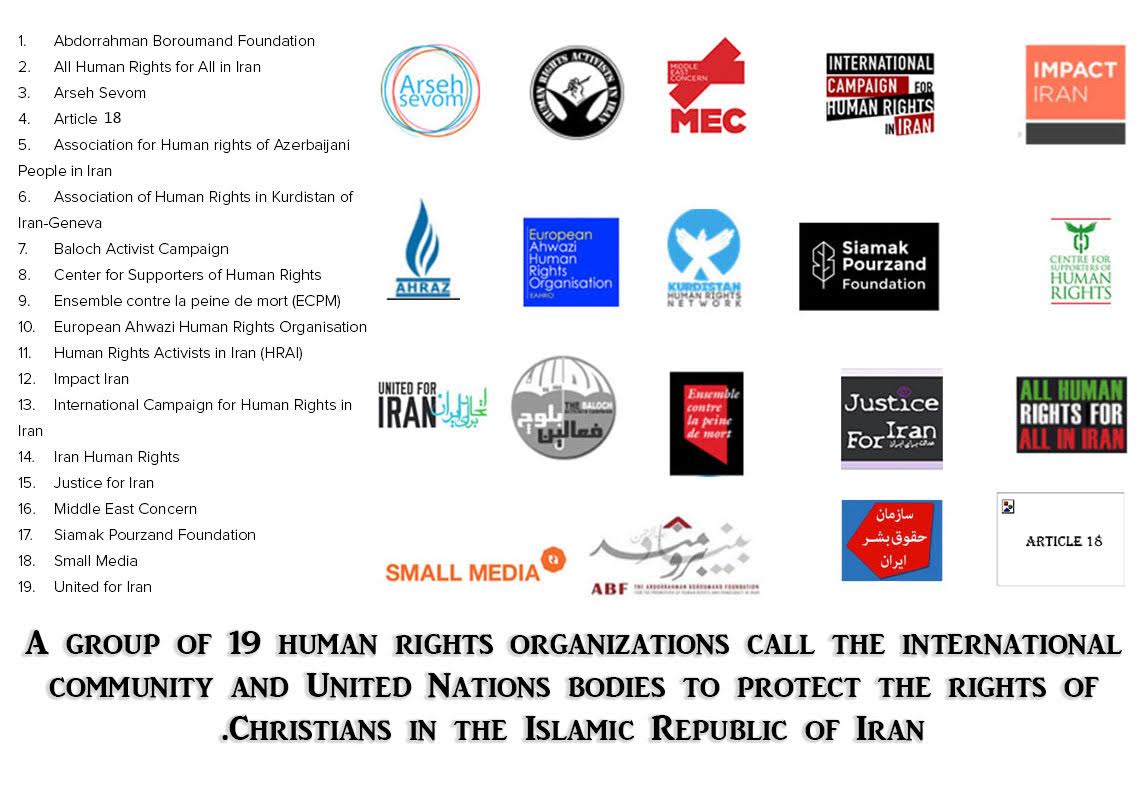
A group of 19 human rights organizations call the international community and United Nations bodies to protect the rights of Christians in the Islamic Republic of Iran

November 28 2016

A group of 19 human rights organizations call the international community and United Nations bodies to protect the rights of Christians in the Islamic Republic of Iran.

In the summer of 2016, Iranian authorities increased their persecution of Christians, honing in on converts from a Muslim-background.

Between May and August 2016, in locations across Iran, security forces arrested a total of 79 Christians, according to information sourced, family members, and friends. The majority of those arrested were interrogated and detained for periods ranging from a few days to months. At the time of writing, some of these 79 Christians remain in detention and have still not been formally charged. Rights groups believe the true number of Christians apprehended by the authorities could be notably higher, as many arrests would have gone unreported.

In 2012 the Iranian government instituted polices to bar converts from Muslim backgrounds from attending services in official churches. Instead, Christian converts are forced to gather in informal groups known as “house churches”. These gatherings are considered illegal by authorities and are often raided. In August 2016 alone, security agents allegedly raided at least four house churches and the house church members were arrested and interrogated.

The individuals responsible for the house church often face charges of “acting against national security through the establishment of house churches”. A group of four converts from Rasht were arrested in May 2016 and charged with acting against national security. A verdict is still pending from their hearing on 15 October 2016. Three of those men also faced charges of drinking communion wine and are appealing their sentence of 80 lashes each. Many others of those recently arrested are still waiting to know what charges will be brought against them.

Iranian authorities have put pressure on Christian leaders to emigrate, either through direct threats or through intentional harassment. Some church leaders have reportedly been told during interrogation that they will face 5 to 10 years in prison unless they leave the country. In other instances, Christians have said that harassment has taken the form of a daily summons to security offices for questioning, confiscation of documents such as identity cards to prevent the victim from buying or selling property or cars or forcing the Christians out of their jobs.

This pattern of treatment of Iranian Christians and converts violates Iran’s Constitutional and international legal obligations. Article 14 of the Islamic Republic’s constitution contains provisions, which uphold basic religious rights for some non-Muslims including Christians, Jews, and Zoroastrians. Article 19 also enshrines the principle of non-discrimination and article 23 prohibits authorities from investigating a person’s belief or taking action against someone solely on account of his or her beliefs.

As a state party to the International Covenant on Civil and Political Rights, the Islamic Republic of Iran is obligated to ensure non-discrimination under articles 2 and 26 and freedom of thought, conscience and religion under Article 18. Article 18 specifically protects the right of a person to change their religion.

THE INTERNATIONAL COMMUNITY

Since the lifting of international sanctions under the Joint Plan of Action, governments worldwide have been showing a commitment to improving relations with Iran and developing business opportunities. In June 2016, for example, the European Parliament published an analysis of EU-Iran relations in the wake of the nuclear agreement, entitled “An EU strategy for relations with Iran after the nuclear deal”. The strategy disappointingly includes very little mention of human rights.

We suggest the following response from the international community and the Islamic Republic:

(1) Governments should factor human rights, including the rights of religious minorities, into all bilateral dealings with the Islamic Republic. Governmental agencies should explore avenues beyond dialogue alone to ensure human rights violators are held accountable and that trade and diplomatic relations do not contribute to further abuses.

(2) The Secretary General and newly appointed Special Rapporteurs on freedom of religion and human rights in Iran should monitor and report extensively on violations of freedom of religious of people in Iran, in accordance with their mandates before the United Nations.

(3) The Islamic Republic of Iran must ensure that the values enshrined in the Iranian Constitution, the Universal Declaration of Human Rights, and the International Covenant on Civil and Political Rights are upheld and that the right to freedom of religion and belief, including the right of conversion and of non-belief, for all its citizens and residents of the country to be respected.

Sincerely,

  1. Abdorrahman Boroumand Foundation
  2. All Human Rights for All in Iran
  3. Arseh Sevom
  4. Article 18
  5. Association for Human rights of Azerbaijani People in Iran
  6. Association of Human Rights in Kurdistan of Iran-Geneva
  7. Baloch Activist Campaign
  8. Center for Supporters of Human Rights
  9. Ensemble contre la peine de mort (ECPM)
  10. European Ahwazi Human Rights Organisation
  11. Human Rights Activists in Iran (HRAI)
  12. Impact Iran
  13. International Campaign for Human Rights in Iran
  14. Iran Human Rights
  15. Justice for Iran
  16. Middle East Concern
  17. Siamak Pourzand Foundation
  18. Small Media
  19. United for Iranunnamed

Report on the situation of Iranian Azerbaijanis regarding human rights: August 2016

August  2016                                                                                                                     Ahraz-1602/016

Report on the situation of Iranian Azerbaijanis regarding human rights:

Ayat Mehrali Baglou:

On 3 August, Ayat Mehrali Baglou, one of the prominent Iranian Turk prisoner was sent to a three-day furlough from Tabriz central prison.

It needs to be mentioned that Mr. Mehrali Baglou, along with other four members of the Board of Directors of Yeni GAMOH Party were sentenced to 9 years in prison in June 2013 by The Revolutionary Court of Tabriz. The prominent activists, Shahram Radmehr, Latif Hasani, Mahmoud Fazli, Behboud Gholizadeh and Ayat Mehrali Bayglu had been arrested on the charge of forming an illegal group, the New Southern Azerbaijan National Awakening Movement Party (Yeni GAMOH), and distributing anti-government propaganda in February 2013.

As further information, YeniGamoh party was about to apply for registration at Ministry of Interior of the Republic of Iran that all the founders were arrested. The party was going to defend minority rights for Iranian Turks.

Workers’ Strike at Iran-Transfo factory in Zanjan:

On 10 August, after 17 days strike, the workers at Iran-Transfo factory ended their protest due to an agreement with the employers.

The agreement, which includes six articles, deals with that the Laid-off workers will return to work and the employer, will stop downsizing policies.
The reason for the strike has been the fact that the downsizing policies of the factory have caused concern about workers’ future career.

Mohammad Jarahi:

Mohammad Jarahi, labour activist and trade union member released after serving his sentence from Tabriz prison on 9 August 2016.

The labour activist and former worker in Asalouyeh zone, was arrested in 2011 for his union activities, on charge of assembling an illegal group and cooperation in propaganda against the regime. He was sentenced to 5 years in prison by judge Hamlbar, in branch number one of the revolutionary court of Tabriz.

Mohammad Jarahi was arrested in 2011, along with other labour activist Shahrokh Zamani. He had been deprived from medical treatment though he was suffering is suffering from high blood pressure, high blood sugar level, high lipids and neck problem.

Labours’ strike at Mashin-Sazi factory in Tabriz:

Labours at Mashin-Sazi factory in Tabriz went on strike on 9 August 2016, to protest against the privatization process of the factory as well as three months unpaid wages.

Mashin-sazi, established in 1963, has been one of the main industrial plants in Azerbaijan region. In 2003 the privatization process began but it has not succeeded so far, however it has been passed among several semi-governmental organizations.

Behzad Qanbari:

On 11 August 2016, Behzad Qanbari, Azerbaijani Turk civil activist was detained by security officers at his working place in the Qara Ziaeddin City of West Azerbaijan Province. He is now held at Tabriz Intelligence Detention Centre. It is said his detention is in relation to the protests against racist insults published in the “Tarhe No Newspaper”. Security officers have told Behzad that he was detained because of his activities related to separatism.

Jafar Rostami Rad:

On 15 August 2016, Jafar Rostami Rad, Azerbaijani Turk civil activist was detained by security officers at the city of Ardabil. He was then released after two days from Evin Prison. Previously, in February 2015, he was detained altogether with other 18 people during football match between Tractor Sazi and Aljazeera teams at the Yadegare Emam Stadium and was sentenced to three months in prison and 30 lashes- The latter was suspended for two years.

 Babak Hoseyni:

On 7 August 2016, Babak Hoseyni, Azerbaijani Turk civil activist was released from Tabriz Central Prison on bail. He was accused of assembly, collusion and propaganda against regime.

 Ibrahim Nouri:

On 8 August 2016, Ibrahim Nouri, Azerbaijani Turk civil activist was released on guarantee from Ahar City Prison after 22 days in detention. He had been on hunger strike for 12 days to protest against his unjustified detention which was said to be assembly and collusion against national security.

On 17 July 2016, Ibrahim was summoned to the Ahar City Court and was then transferred to Ahar Prison because of not paying bail. The reason for his detention was said to be “to prevent crime” considering his previous activities around the “Day of Quds”.

Akbar Jahanigiri:

On 30 June 2016, Akbar Jahanigiri was detained in Ahar City and was released after a day. He was detained because he was refused to go to the court.

 Siyamak Rezaei:

On 14 July 2016, security forces arrested Siyamak Rezaei at his working place in the Parsabad City of Ardabil Province. They also searched his house and confiscated his private belonging such as books and computer. No reason and accusation has been announced yet. On 15 August 2016, Siyamak`s wife got to know the prolongation of his husband`s detention for one more month, through Tehran Province Revolutionary Court.


Report on the situation of Iranian Azerbaijanis regarding human rights: Ahraz-1602/015

July 2016                                                                                                                                                     Ahraz-1602/015

Report on the situation of Iranian Azerbaijanis regarding human rights:

Execution of a prisoner in Maragheh Prison:

A prisoner with drug related charges has been executed in Maragheh prison on July 11, 2016. The prisoner was Hadi Pashaei, age 33, who was waiting in death raw for 8 years in prison of Maragheh. It is declared that his accusation was drug related. Source: Oyan News

Mohammad Rashidi was released after serving out his sentence:

Political prisoner Mohammad Rashidi released from Tabriz prison after serving out his sentence on July 30, 2016. On May 30, 2016, He had arrested and transferred to Tabriz prison to serve his sentence.

In August 2013, Rashdi was sentenced to 4 months in prison by the third branch of Tabriz Revolutionary Court on the accusations of assembly and propaganda against regime. On 30 April 2013, Rashidi was arrested in Tabriz together with Amir Hadian, Azerbaijani folk musician Ashiq Eisa Qarakhanli, along with two citizens of the Republic of Azerbaijan; Khalide Khalid (Historian and member of the Azerbaijani science academy) and Shamkhal Hoseynov. On 25 June 2013, Rashidi was released on bail from Tabriz Central Prison after 56 days in temporary detention.

Previously, on 15 August 2012, Rashidi along with three other Azerbaijani Turk activists, was detained by the security forces while they were delivering assistance to the earthquake-affected people of Varzghan which had been 4 months in prison, issued at the third branch of Tabriz Revolutionary Court in July 2013.

Shahram Radmehr was released on parole:

On 16 July 2016, Mr. Shahram Radmehr, one of the most prominent Iranian Turk activist was released on parole after 43 months imprisonment from Meshkin-shahr prison.

It needs to be mentioned that Mr. Radmehr, along with other four members of the Board of Directors of Yeni GAMOH Party were sentenced to 9 years in prison in June 2013 by The Revolutionary Court of Tabriz. The prominent activists, Shahram Radmehr, Latif Hasani, Mahmoud Fazli, Behboud Gholizadeh and Ayat Mehrali Bayglu had been arrested on the charge of forming an illegal group, the New Southern Azerbaijan National Awakening Movement Party (Yeni GAMOH), and distributing anti-government propaganda in February 2013. Before, Mr. Radmehr, Mahmoud Fazli and Behboud Gholizadeh had also been released as conditional freedom. The parole for the other prisoners of Yeni Gamoh founders has been rejected several times so far.

As further information, YeniGamoh party was about to apply for registration at Ministry of Interior of the Republic of Iran that all the founders were arrested. The party was going to defend minority rights for Iranian Turks.

Mass arrests of the activists during the Mass protest in Azerbaijani cities of Iran:

Following the protests in various cities of Azerbaijan provinces (with the majority of Turk population) in response to an article, which published in the newspaper of “Tarhe No”, a wave of arresting protesters in these cities began. Here is the known list of the activist, who been arrested and their last situation.

More information about the protests The Newspaper “Tarhe No” published an article, which included racist insult against Turk and women published on 20 July 2016. “Turks has bad race like women” was one the sentences on a story for children in the newspaper. The newspaper “Tarhe No”, which is published in Tabriz (the greatest city of Iranian Turks), is known to be close to Iranian Inelegance Service. Previously the newspaper had also published many insulting articles against activists and civil society members.

As protest against the racist publication, there were demonstrations, which held by the Turk activists in many of Azerbaijani cities in Iran including Ourmia, Tabriz, Ardebil, Zanjan, Khoy etc. The protests began on 25 July 2016 and lasted for some days. Although the demonstrations have been peaceful and non-violent, many of activists were been arrested or summoned by police and Intelligent forces.

Houshang Naghizadeh:

Houshang Naghizadeh was arrested before the beginning of the demonstration in Ourmia and transferred to the Police Detention Center of “9 Pelleh” on 25 July 2016. The day after, he wes charged with “to motivate young people to participate to the demonstration” at the 6th branch of the prosecutorial Office in Ourmia. Afterward he we released on bail of 100 million IR. Mr. Naghizadeh had previously been arrested in connection with the ceremony of universal day for “mother tongue” in 2006.

Ali Azizi:

Ali Azizi was arrested at the demonstration against the racist publication on “Tarh No” newspaper in Ourmia on 25 July 2016. He was released after signing a commitment. Ms. Ulduz Ghasemi was arrested at the demonstration against the racist publication on “Tarh No” newspaper in Ourmia on 25 July 2016. She was released after a couple of hours. Mrs. Ghasemi is on the Turk civil society activists who has been arrested in the past.

Tohid Rostamian, Ali Asghari, Hamed Nemati, Bahman Hoseini, Soleiman Choupani and Ali Shir Javan:

Tohid Rostamian, Ali Asghari, Hamed Nemati, Bahman Hoseini, Soleiman Choupani and Ali Shir Javani were arrested at the demonstration protesting against the racist publication on “Tarh No” newspaper in Tabriz on 26 July 2016. They all were released the day after. According to those who were released, there have been six other activists who have been transferred to Tabriz prison and some to the Revolutionary Guard custody.

Ms. Roghayyeh Alizadeh

Ms. Roghayyeh Alizadeh was arrested when she was filming the demonstration against the racist publication on “Tarh No” newspaper in Tabriz on 26 July 2016. She was released after the police seized her cell phone.

Reza Soleimanzadeh and Majid Haghverdi:

Reza Soleimanzadeh and Majid Haghverdi were arrested at the demonstration against the racist publication on “Tarh No” newspaper in Tabriz on 26 July 2016. According to HRANA, they have been transferred to Tabriz Prison.

Rouzbeh Piri, Ali Jabbari, Ali Hedayati, Ali dabbaghi. Ms. Nayyer Fathalilou and Ms. Marayam Fathalilou:

Rouzbeh Piri, Ali Jabbari, Ali Hedayati, Ali dabbaghi. Ms. Nayyer Fathalilou and Ms. Marayam Fathalilou Were arrested at the demonstration protesting against the racist publication on “Tarh No” newspaper in Tabriz on 28 July 2016. There is no information about their situation up to now.

Mohammad Jolani, Ahmad Mohammadzadeh, Vahid Sadeghi Fard and Hosein Balakhani:

Mohammad Jolani, Ahmad Mohammadzadeh, Vahid Sadeghi Fard and Hosein Balakhani were arrested at the demonstration protesting against the racist publication on “Tarh No” newspaper in Ardebil on 28 July 2016. There is no information about their situation up to now.

Mehdi Houshmand and Reza Vahdat:

Mehdi Houshmand and Reza Vahdat were arrested in connection with the demonstration protesting against the racist publication on “Tarh No” newspaper in Ardebil on 27 July 2016. The have been beaten during the arrest. There is no information about their situation up to now. Abolfazl Imani and his 7-year-old daughter Aylar Imani, were arrested at the demonstration protesting against the racist publication on “Tarh No” newspaper in Zanjanl on 28 July 2016. Aylar was delivered to her family after a couple of hours but Mr. Imani was released one day after within a waranty bail.

Salman Araghi, Vahed Safari, Javad Alizadeh, Farhad Soleimanpour, Hosein Bostanchi, Mohammad Hadi Abbaszadeh, Mehrab Kazemloui and Said Varmazyar:

Salman Araghi, Vahed Safari, Javad Alizadeh, Farhad Soleimanpour, Hosein Bostanchi, Mohammad Hadi Abbaszadeh, Mehrab Kazemloui and Said Varmazyar were arrested at the demonstration protesting against the racist publication on “Tarh No” newspaper in Khoy on 28 July 2016. They were beaten by Police forces so that Mr. Bostanchi head was bloody and transferred to hospital. All the detainee have been released on bail the day after. The Prosecutorial office of the Revolutionary Court in Khoy has charged them with “disturbing public order”.

Ali Ebrahimi:

Ali Ebrahimi was arrested at the demonstration protesting against the racist publication on “Tarh No” newspaper in Tehran on 26 July 2016. According to Hrana, his situation is unknown yet.

Morteza Karimi:

Morteza Karimi was arrested in connection with the demonstration protesting against the racist publication on “Tarh No” newspaper in Maragheh on 26 July 2016. According to Hrana, his situation is unknown yet.

Amir Esmail:

Amir Esmail Yar has been summoned by Police in Ourmia in connection with the demonstration protesting against the racist publication on “Tarh No” newspaper.

Nouri and Akbar, Akbar Jahangirzade, Akbar Jahangirzade, Akbar Jahangirzade :

On 30 June 2016, Ibrahim Nouri and Akbar Jahangirzade from Ahar City as well as c and Ali Hamzezade from Tabriz City were detained by security officers. Ibrahim Nouri and Akbar Jahangirzade were released after a day in detention.

On 17 July 2016, Milad Akbari and Ali Hamzezade were released from Tabriz Central Prions on bail after 17 days in detention. These two activists went on hunger strike after their arrival in detention centre because of the lack of clarity about reason for their detention.

Habib Sasanian:

Habib Sasanian who had been transferred to solitary confinement of Tabriz Central Prison after a month detention in the Tabriz Intelligence Detention Centre has been now transferred to the section 12 of this prison. He has been also taken to the Tabriz Intelligence Department several times during his time in prison.

In April 2016, Habib Sasanian altogether with Mehdi Javadzade, Hamid Saghafi, Babak Avand, Ismail Afkhami and Younes Rahimi were detained. In June 2016, the general attorney of East Azerbaijan courts introduced these activists as “six members of the spy organization, GAMOH”. As the general attorney claims these activists collected classified military and economic documents and delivered them to the enemies of the state.

Siyamak Mirzaei:

On 14 July 2016, Siyamak Mirzaei from Parsabad Moghan was arrested at his working place and transferred to Ardabil Intelligence Centre. He has been now transferred to the Evin Prison. This activist was arrested in October 2011 during protests against drying up of Urmia Lake. Earlier, he was arrested by the security forces in 2006, 2007 and 2010 and was sentenced on the accusations of organizing groups and attempts against national security.

Three Cristian citizens from the Republic of Azerbaijan:

On 24 June 2016, three Cristian citizens from the Republic of Azerbaijan who were on trip in Iran were arrested in Karaj City by the plain-coated forces of the Intelligence Department of the Revolutionary Guardian Corps. These Christians were residing at a home belonging to an Iranian Christian. They were then transferred to an unknown location. The name of these detainees are Bahram Nasibof Elkhan, 37 years old man, Yusuf Farhadof Talet Oghlu, 52 years old and Eldar Ghurbanof, 48 years old.

Tractor Sazi football:

Seven detainees related to the arrests from the first Asian football match of Tractor Sazi football team were sentenced to totally 49 months in prison by the Tabriz Revolutionary Court. Jafar Rostami Rad, Ali Ahmadi, Ali Sarraf, Ali Saadati, Asghar Ebadzade, Kasra Davoudi and Siyamak Seyfi were sentenced each to seven months in prison. These activists are accused of propaganda against regime.

On 8 March 2013, during the first Asian football match of Tractor Sazi Team against Aljazeera Team from UAE, tens of Azerbaijani people and Tractor Sazi fans were arrested in Tabriz city.

Transfo Factory at Zanjan:

Many of factory workers, approximately 500 workers at Iran Transfo Factory at Zanjan City gathered to protest against the changes that are being taking place in the factory. The authorities have not responded to these protests. This factory is the largest producer and exporter of the electricity transformers in the Middle East.

Pourandokht Misaghi:

Pourandokht Misaghi, a Bahai citizen from Tabriz City passed away on 12 July 2016. After her death, her body was buried by the officials arbitrarily at a remote cemetery at the outskirts of Miandoab City. Only after a week and after insistence made by the family of the deceased, the officials revealed location of the burial. It was ordered that only ten people could attend the burial ceremony. She was wife of Allahverdi Misaghi Mamaghani who was hanged along with other seven Bahai citizens after 16 months in prison on 29 July 1981.

Report on the situation of Iranian Azerbaijanis regarding human rights Juni 2016

June 2016                                                                                                                                                 Ahraz-1602/014

Report on the situation of Iranian Azerbaijanis regarding human rights:

Habib Sasanian, Esmail Afkhami, Mehdi Javanzadeh, Hamid Saghafi, Babak Avand and Younes Rahimi:

According to the report of HRANA, Dr. Ismail Afkhami, who had been detained in Ardabil about a month ago, was released on the bail of 3 billion IRR from Tabriz Central Prison on June 8, 2016. Also Mr. Yones Rahimi, was released a few days ago though the condition for his freedom is unknown. There is no information about situation of the other detainees of the above-mentioned activists.

Approximately a month ago, six Iranian Turk activist had been arrested in Ardabil, northwest Iran.The place to which they had been transferred was totally unknown until Habib Sasanian could ring his family informing that he was being kept at the custody of Iranian Intelligence Service in Tabriz. After a while Yones Rahimi, Habib Sasanian and Esmail Afkhami had been transferred to Tabriz Central Prison. Among them Yones Rahimi and Esmail Afkhami have been released recently. However the fate of other detainees is not clear so far. It is said the families of the detainees are under pressure not to speak to the media.

All of them were active in protesting against Iranian government to stop supporting Armenia in the conflict between Armenia and Republic of Azerbaijan.

 25 Bahai-run business have been closed down by authorities in Urmia.

According to BahaiNews website, during two week in May and June 2016 the Public Places Office have shut-down more than 28 Baha’i-owned businesses in the city of Urmia, the Azerbaijani city in northwest Iran.

Based on the source’s information, after officials from the Public Places Office shut down these businesses, no information regarding these shut-downs has been found so far. According to an informed source, “none of the governmental bureaus or organizations took responsibility for these shut-downs; even the Intelligence Ministry Office in the City would not respond. After ten days of continuous follow-up by these Baha’i Citizens, the Public Places Office has stated that the Intelligence Ministry was the party requesting the shut-downs.”

In the past few years, the Public Place Office has sealed many Baha’i-owned businesses. It is supposed that the reason behind the shut-down of the Baha’i-owned businesses to be because of opposition of the Intelligence Ministry to Baha’i companies closing on the nine Baha’i religious holidays.

The first trial session for mother language rights defender was held:

On 16 June 2016, the court session of 8 civil rights activists in the city of Baharestan was held by the judge Mr. Hasani, Head of the judiciary office in the city.
Akbar Azad, Alireza Farshi, Behnam Shaikhi, Hamid Manafi Nazarloo, Rostam Kazampoor, Mansour Fathi, Aziz Farshi and Mahmoud Ojaghlou are the Iranian Turk activists who had participated in the court session. They had been arrested in Feburary 2014, in connection with the ceremony of The International Mother Tongue Day in the city of Nasim Shar near Tehran. They all had been transferred to the prison of Evin at which been kept for several months. The accusation against the activists has been ““participation in illegal gatherings against national security”.

Bahboud Gholizadeh was relead on parole:

On 16 June 2016, Behboud Golizadeh, one of the most prominent Iranian Turk activist was released on parole after 40 month imprisonment in Tabriz Central Prison.

It needs to be mentioned that Mr Gholizadeh along with other four members of the Board of Directors of Yeni GAMOH Party were sentenced to 9 years in prison in June 2013 by the rovelutionary court of Tabriz. The prominenet activists, Latif Hassani, Mahmoud Fazli, Shahram Radmehr, Ayat Mehr Ali Bayglu and Behboud Gholi Zade had been arrested on the charge of forming an illegal group, the New Southern Azerbaijan National Awakening Movement Party (Yeni GAMOH), and distributing anti-government propaganda in February 2013.

Before, Mr. Mahmoud Fazli had also been released as conditional freedom in November 2015. The parole for the other prisoners of Yeni Gamoh founders has been rejected several times so far.

“Elin” magazine:

After release of the ninth issue of a student magazine called “Elin” in the spring of 2015, the supervising committee over publications at the University of Maraghe City ordered suspension of “Elin” magazine for a year. This committee summoned Milad Balsini, the director responsible for the magazine. Milad Balsini the former director of this magazine told to Oyan News that the authorities of Maraghe University intended to cancel licence for the publication of this magazine through unjustified excuses. Following suspension of the above-mentioned magazine, the disciplinary committee of the Maraghe University condemned Milad Balsini to reprimand and formal filing of the case as well as temporary suspension from education for half a year. This Quarterly student magazine was publishedin to two languages of Azerbaijani Turkic and Farsi, which was directed by Milad Balsini, a member of Azerbaijan-ology Club at the Maraghe University since four years.

Rasoul Razavi:

In recent days and after that Rasoul Razavi has ended hunger strike to be prepared for legal proceedings, a court session was held in the general court of Tabriz city under strong security considerations. Rasoul Razavi had started a hunger strike since 19 May 2016. This civil rights activist was detained in Tabriz city on 12 November 2015 during massive anti-racist demonstrations in the Azerbaijani region of Iran.

Rahim Zareei:

On 29 June 2016, Rahim Zareei, civil rights activist from Tabriz city was released after four-day detention in the Tabriz Intelligence Department. His father`s house was also searched by the security forces and so his private belongings such as his computer, notes and telephones became confiscated. Before his arrest, security forces had asked him many times through telephone calls to go to the Tabriz Intelligence department, but he had refused to do so and had asked for the delivery of formal court order.

Jafar Azimzadeh:

Jafar Azimzadeh imprisoned labor activist who was released on furlough after 64 days of hunger strike was hospitalized in Ateyeh hospital due to his critical condition.

Jafar Azimzadeh who was released on furlough due to authorities’ promised for a retrial after 64 days of hunger strike was hospitalized in Ateyeh hospital due to his critical health condition.

On 1 July 2016, by on-going intestinal bleeding he also suffered serious stomach problems and his doctor announced that by continuing the hunger strike he would go into coma and there was also the risk of death.

Jafar Azimzadeh was sentenced to six years imprisonment and two years deprivation of ‘activities in cyberspace and the media and the press’ by the Revolutionary Court in 2015.

The labor activist was one of coordinators of scroll of the petition signed by forty thousand workers to increase the minimum income. He has been sentenced to six years in total on charges of gathering and colluding with intention to act against the national security, disturbing public order and propaganda against the regime.

Salvati, judge of branch 15 of Tehran Revolutionary Court, has not accumulated the labor activist’s time under detention in the verdict.

Azimzadeh’s charges were, the formation of the Free Union of Iranian Workers, the formation of the National Union of Dismissed and Unemployed Workers in cooperation with the Committee of Labor Unions, gathering in  Laleh Park in 2009 at the International Workers’ Day, guiding the labors in a protest in 2005, constituting, planning and management of workers’ protests in 2014.

Azimzadeh also has been sentenced because of gathering signatures for the petition of forty thousand workers and protest in front of Parliament and the Ministry of Labor, protesting against the approved basic income, being the representative of thousands of workers against Saeed Mortazavi, protesting against the changes in labor law, meeting with other independent workers’ organizations such as Syndicate of Workers of Tehran and Suburbs Bus Company, Syndicate of Workers of Neishekar, the Coordinating Committee and interviews with some overseas media.

Jafar Azimzadeh was arrested on the eve of May Day in 2014 in Tehran by security agents and after 46 days was released from Evin prison on a bail of 1 billion IRR.

On November 8, 2015 according to the warrant of Branch 1 of Enforcement Criminal Court for the District 33 of Evin, for serving his sentence he showed up at prosecutor’s office in Evin prison and was transferred to ward eight.

Background:

Jafar Azimzadeh, jailed trade unionist was sent to furlough by end of his hunger strike and promised an investigation into the case, after 64 days of hunger strike on June 30. Probably the labor activist will be admitted in another hospital due to his physical condition’s deterioration by his family’s decision.

Jafar Azimzadeh ended his hunger strike at 8 PM on Thursday, June 30, 2016, by adopting a retrial and impartial investigation of the case and extendable furlough and was released from the hospital by family.

Jafar Azimzadeh was sentenced to six years imprisonment and two years deprivation of ‘activities in cyberspace and the media and the press’ by the Revolutionary Court in 2015.

The labor activist was one of the coordinators of the petition signed by forty thousand workers to increase the basic income. He has been sentenced to six years in total on charges of gathering and colluding with intention of acting against the national security, disturbing public order and propaganda against the regime.

Salvati, judge of branch 15 of Tehran Revolutionary Court, has not accumulated the labor activist’s time under detention in the verdict.

Azimzadeh’s charges were formation of the Free Union of Iranian Workers, formation of the National Union of Dismissed and Unemployed Workers in cooperation with the Committee of Labor Unions, gathering in Laleh Park in 2009 at the International Workers’ Day, guiding the labors in a protest in 2005, constituting, planning and management of workers’ protests in 2014.

Azimzadeh also has been sentenced because of gathering signatures for the petition of forty thousand workers and protest in front of Parliament and the Ministry of Labor, protesting against the approved basic income, being the representative of thousands of workers against Saeed Mortazavi, protesting against the changes in labor law, meeting with other independent workers’ organizations such as Syndicate of Workers of Tehran and Suburbs Bus Company, Syndicate of Workers of Neishekar, the Coordinating Committee and interviews with some overseas media.

Jafar Azimzadeh was arrested on the eve of May Day in 2014 in Tehran by security agents and after 46 days was released from Evin prison on a bail of 1 billion IRR.

On November 8, 2015 according to the statement of Branch 1 of Enforcement Criminal Court for District 33 of Evin, for serving his sentence he introduced himself to prosecutor’s office in Evin prison and was transferred to ward eight.

On June 29, Jafar Azimzadeh’s relatives and colleagues held a rally in support of the imprisoned worker who had spent 64 days on hunger strike in front of the President’s Office (Pasteur St).

According to the report of Human Rights Activists News Agency (HRANA), following the recall on June 28, Jafar Azimzadeh’s relatives and colleagues held a rally in support of the imprisoned worker who had spent 64 days on hunger strike in front of the President’s Office on June 29.

At the rally, the demonstrators chanted slogans such as “Workers should not be in prison, Jafar Azim Zadeh at risk, every time a disaster”.

According to one participant, the continued presence of demonstrators increased the security atmosphere and the commander of the police called them to disperse. Ms. Mohammadi and Ms. Azim Zadeh expressed the demonstrators’ demands as their delegates, finally. The delegates gathered in front of Presidential building and negotiated with the authorities.

It is worth noting that the participants at the rally then went to Sina hospital to visit Jafar Azimzadeh and peacefully left the hospital by the opposition of security officers and request of Ms. Azimzadeh.

Abbas Jafari Dowlatabadi, Tehran’s prosecutor after accepting to meet the wife of Jafar Azimzadeh, secretary of the board of the Free Trade Union of Workers in Iran imprisoned at Evin Prison on 59th day of hunger strike, told her that he would do nothing for her husband even if he dies, yesterday.

Jafar Azimzadeh, imprisoned labor activist at ward 8 of Evin prison has been recently kept at Sina Hospital in Tehran following the deterioration of his health condition. He is on the 60th day of hunger strike protesting “suppression labor and teacher activists through security charges”.

“Mr. Azimzadeh’s wife went to meet Mr. Jafari Dowlatabadi to follow the case of her husband and his demands. But Mr. Dowlatabadi told her with anger that he would do nothing for him, even if he would die. He is responsible for it and it’s no one’s business.” A source close to Jafar Azimzadeh told HRANA, yesterday.

Jafar Azimzadeh was sentenced to six years imprisonment and two years deprivation of ‘activities in cyberspace and the media and the press’ by the Revolutionary Court in 2015.

The labor activist was one of coordinators of scroll of the petition signed by forty thousand workers to increase the basic income. He has been sentenced to six years in total on charges of gathering and colluding with intention of acting against the national security, disturbing public order and propaganda against the regime.

Salvati, judge of branch 15 of Tehran Revolutionary Court, has not accumulated the labor activist’s time under detention in the verdict.

Azimzadeh’s charges were formation of the Free Union of Iranian Workers, formation of the National Union of Dismissed and Unemployed Workers in cooperation with the Committee of Labor Unions, gathering in Laleh Park in 2009 at the International Workers’ Day, guiding the labors in a protest in 2005, constituting, planning and management of workers’ protests in 2014.

Azimzadeh also has been sentenced because of gathering signatures for the petition of forty thousand workers and protest in front of Parliament and the Ministry of Labor, protesting against the approved basic income, being the representative of thousands of workers against Saeed Mortazavi, protesting against the changes in labor law, meeting with other independent workers’ organizations such as Syndicate of Workers of Tehran and Suburbs Bus Company, Syndicate of Workers of Neishekar, the Coordinating Committee and interviews with some overseas media.

Jafar Azimzadeh was arrested on the eve of May Day in 2014 in Tehran by security agents and after 46 days was released from Evin prison on a bail of 1 billion IRR.

On November 8, 2015 he was summoned to Evin Prison to serve his sentence.

Source: HRANA News Agency


Report on the situation of Iranian Azerbaijanis regarding human rights May 2016

May 2016                                                                                Ahraz-1602/013

Report on the situation of Iranian Azerbaijanis regarding human rights:

Soheila Kargar:

On May 15 2016 Turk civil rights activist Mrs. Soheila Kargar was arrested at her home by Iranian security forces in Northwestern city of Qazvin. She has been released on bail on 2nd June.

According to AHRAZ, the arrest was violent and without presenting any warrant. Her brother Javad Kargar confirmed that “At 10 am on Sunday, May 15, 2016 security officers who had introduced themselves as electrical officers, entered to Soheila Kargar’s house and arrested her violently without presenting any warrant. She was beaten when they handcuffed her so that her face got a bruise for a while. The security forces did not mention either why they arrested Mrs. Kargar or where they were going to take her. They messed the house and sized all the laptop, books, CD etc.”

Two days later, Mrs. Kargar’s family could find out that the responsible judge for the case is Mr. Baghdadi at Branch 3 of Court of Qazvin. The 4th day after the arrest within her family insistence Mr. Baghdadi announced that she was transferred to Evin prison in Tehran. In the evening of that day Soheila rang her family from Evin prison and told that “she was all right and the interrogators had dealt with her respectfully and she was held in solitary confinement.” according to Javad Kargar.

Mrs. Kargar’s family was been informed that the accusation for the arrest is “founding an illegal group”. So far AHRAZ has not received any details about the accusation. Finally on 2nd June after 18 days of being in confinement at Evin prison, Soheila Kargar was released from Qazvin prison on the bail of 500 million IRR.

Mrs. Kargar, the turk activist, whose activities have been on the ethnic rights and women’s rights. She was candidate for parliamentary elections in city of Qazvin however she was refused approval Guardian Council. She is married and has a 5-year-old girl.

Flogging, imprisonment and fine against 26 Turk activists in Tabriz:

On 31 May 2016, Branch 112 of the Criminal Court in Tabriz sentenced 26 fans of Tractorsazi FC of Tabriz to flogging, fines and imprisonment on charge of “disturbing the public peace through participation in clamouring”.

The activists had been arrested during during the football match between Tractor and Siyah Jamegan teams on November 20, 2015 following the “Anti-racism” mass protest in Azerbaijani cities in Iran. They had been transferred to Tabriz Central Prison and released on the bail after one day of detention.

According to the report of Human Rights Activists News Agency in Iran (HRANA), the trial had been held at Branch 112 of Criminal Court headed by Judge Ali Piri On May 22, 2016.

Based on the verdict, the activists; 1.Amin Seraj Rezaee 2.Mohammad Bagher Harirchi 3.Ahad Ebrhimpour 4.Majid Jaefarzadeh 5.Mir Mohammad Babaee 6.Farzad Nasiri 7.Siamak Makhmouri 8. Javad Soltani 9.Yavar Soltani 10.Hasan Ebrahimpour 11.Arouj Dehghani 12.Maysam Khalafi Zangi 13.Mohsen Hosseinzadeh 14.Jahanbakhsh Soltanzadeh have been sentenced to pay five million IRR fines instead of imprisonment and three million IRR fines instead of whip as well as the activists 15.Mehdi Shirzad 16.Hadi Hosseinzadeh 17.Farzad Haydari 18.Ali Rshidi 19.Majid Naghizadeh 20.Rasoul Mohammadi Malalar 21.Amir Karimi 22.Shahin Shirinazhad 23.Hassan Jamali 24. Millad Pour Mohammad 25. ESmael Dehghani 26. Karim Hosseinzadeh have been sentenced to “one year and seventy-four lashes”. The verdict has mentioned that an appeal can be made within twenty days after the notification.

Background:

About “Anti-racism protest” in Azerbaijani cities of Iran.

In October 2015, in many cities of Azerbaijan (northwest Iran) and Tehran there were demonstrations against the TV program of “Fitileh” in which the Turks had been humiliated. These demonstrations are known as “anti-racism protests”. Although the demonstrations were peaceful in the beginning but they turned violent as police attacked the protester by tear gases and batons. Hundreds of activists were arrested during the protests in Azerbaijani cities of Iran.

Seventeen workers have been flogged in Azerbaijani city of Tekab:

On 25 May 2016, seventeen workers of the gold mine of Agh-Dare in Tekab (West Azerbaijan province) have been flogged, based on the News Agency of ILNA. It is also reported that some of the workers have been arrested after the implementation of the lash sentence.

According to the workers lawyer Vahid Yarifor, they were sentenced to between 30 and 100 lashes, fine and imprisonment. The trial have been held on two separate court rulings, the branch 110 of Criminal Court in Tekab and branch 10 of Appeal Court in Urmiyeh. The accusation have been The allegations consisted of “preventing people from doing business by disturbing the peace”, “insulting the mine’s security guard”, “destruction of a guard’s clothing and illegally detaining him” and “deliberate destruction of the mine’s signboard” which the suing had been done by the employer.

These workers were sentenced to imprisonment as well, which with the announcement of the withdrawal of the complaint and taking the opportunity of the judicial authority’s pardon, the punishment of imprisonment for all workers was to be cancelled. However, according to Radio Farda news

source, some of the workers have been arrested after the lash sentence has been carried out.

Background:
in December 2014, in protest against the sacking of 350 seasonal workers, a large gathering of laid off workers took place in front of the guards’ house of the “Agh Dare” gold mine in Tekab city in West Azerbaijan province. As protest at the loss of their jobs three of the sacked workers attempted to commit suicide on the mine site but survived after being hospitalised, according to ILNA news agency.

It is said that Agh-Dare is Iran’s second-largest, with more than 30 tons of proven reserves and one of the biggest gold mines in the Middle East. The Pooya Zargan Company operates the Agh-Dare gold mine who had sued the workers.

Morteza Murad:

Tabriz Central Prison officials prevent delivery of optical medicines to the Azerbaijani Turk activist Morteza Murad Pour. He has recently come back to the prison after an emergency leave. He was prescribed to take optical medicines to stop medical problems that his eyes have received. Those close to this activist are concerned if this will intensify his medical problems.

Previously, Tabriz Central Prison officials had also put in effect the same prevention of delivery of optical medicines to another Azerbaijani Turk activist Hoseyn Ali Mohammadi.

Morteza Murad Pour was arrested by the security forces on 18 May 2015 and was transferred to the Tabriz Central Prison. This activist had been sentenced to three years in prison in 2009 in Tabriz Revolutionary Court on the accusations of assembly and offense against security of state and propaganda against regime.

He was also arrested on 22 May 2009 during demonstration at El-Goli Park of Tabriz City after giving slogans in relation to the linguistic and national rights of Azerbaijani people in Iran. He was then released on bail after six months in detention.

Mohammad Rashidi:

On 31 May 2016 Mohammad Rashidi, nick-named Okhtay, was arrested after going to the Tabriz Court to serve his sentence of 4 months in prison. He was then transferred to the Tabriz Central prison.

In August 2013, Rashdi was sentenced to 4 months in prison by the third branch of Tabriz Revolutionary Court on the accusations of assembly and propaganda against regime.

On 30 April 2013, Rashidi was arrested in Tabriz together with Amir Hadian, Azerbaijani folk musician Ashiq Eisa Qarakhanli, along with two citizens of the

Republic of Azerbaijan; Khalide Khalid (Shahriar-olog and member of the Azerbaijani science academy) and Shamkhal Hoseynof.

On 25 June 2013, Rashidi was released on bail from Tabriz Central Prison after 56 days in temporary detention.

Previously, on 15 August 2012, Rashidi along with three other Azerbaijani Turk activists was detained by the security forces while they were delivering assistance to the earthquake-affected people of Varzghan.

Sazi and Al-Nasr of UAE held in Tabriz:

On 24 May 2016, during a football match between Tractor Sazi and Al-Nasr of UAE held in Tabriz, some of the football fans were arrested by the security forces. The name of those arrested have not been identified yet. Only Seyed Vahid Shahbazi, a student of architecture at Ahar University has been mentioned. During this football match, some of the activists had requested release of Azerbaijani Turk political prisoners, through showing placards.

Rasoul Razavi:

Rasoul Razavi Azerbaijani Turk political prisoner is still under hunger strike since 19 May 2016. The reason for the hunger strike is said to be because of unfair legal proceedings, re-execution of omitted court orders and uncertainty of his court file related to the anti-racism demonstrations. His physical situation is deteriorating.

Razavi was detained in Tabriz city on 12 November 2015 after massive anti-racism demonstrations held in different cities of the Azerbaijani region. In October 2015, Branch 2 of the Tabriz Revolutionary Court sentenced Razavi altogether with Hoseyn Rakhshani Kia and Sevindik Lotfi to two years in prison on the accusations of propaganda against regime. This court order was issued after his detention during Quds day because of showing support for Uyghurs being under Chinese repression.

Razavi has been arrested by the security forces, sentenced to prison and put in jail several times in 2011 – 2016. He has been also tortured during his detention at Tabriz Intelligence Detention Centre.

Abbas Lesani:

On 1 June 2016, Abbas Lesani Azerbaijani Turk activist from Ardabil city along with his wife Roghayeh Alizadeh became present at the Branch 1 of Ardabil Revolutionary Court and their court session was held.

The accusation of propaganda against regime was rejected by both Lesani and his wife. Lesani objected against that the court was not held public. This accusation was raised after issuance of his voice message from Ardabil prison in protest against racist Iranian TV program named “Fitileh” targeting

Turks in Iran. His wife has been mentioned to be cooperating in this accusation.

Lesani was released on bail from Adel Abad Prison of Shiraz city on 25 May 2016 after hunger strike that he went under because of lack of release from prison on due time and fabrication of new files against him. There are some 11 other prisoners who went under hunger strike in support for and solidarity with him. Lesani had been exiled to Shiraz Prison and was supposed to be released on 18 May 2016.


Rally of the Ardabil workers:

On 8 May 2016, at the same time of the “Workers Week”, workers of the “largest textile factory in the Middle East” (Arta Tejarat Zarrin) in Ardabil gathered in front of the governor building and demanded investigation into their claims.

At the rally, workers pointed to the economic problems due to lack of demand over the past few years. They demanded the presence of Ardabil governor to handle their problems.

Referring to one of the workers: they did not receive their demands over the past few years, he added, none of the manager of the factory does specify what is the demands of the workers. He noted; the demands and rights of workers have not been paid for years and due to non-payment of receivables, the workers are in debt and surviving by loans, however failing to payback a loan also causes problems for them.

Execution

Prisoner Hanged on Drug Charges in East Azerbaijan province, North-western Iran:

On 12 may 2016 Mr Behnam Mohammadi, 35 years old, was executed after 5 years imprisonment in Maragheh prison, East Azerbaijan province. He was executed on charge of drug-related crime.

Every year a large number of prisoners are executed in Maragheh prison in charge of drug-related crimes.

Reference: Oyan News

Report on the situation of Iranian Azerbaijanis regarding human rights, April 2016

April 2016                                                                                Ahraz-1602/012

Report on the situation of Iranian Azerbaijanis regarding human rights:

 Morteza Nour Mohammadi:

14 March 2016, the Turk activist Morteza Nourmohammadi was released on bail in Shabestar, northwest Iran. Mr. Nourmohammadi had been summoned by the revolutionary court at the same day for which the reason was the suing of the local police. The accusation has been “the Pan Turkism and ethnical propaganda within a book fair”. Mr. Nourmohammadi was arrested after the trial and has been released after a couple of hours on bail of 200 million IRR.

On 3 February 2016, the police banned a book fair organized by the civil society activists in Shabestar seizing all the books though the fair had got the permission from the authorities and all the books were legal.
Previously Morteza Nourmohammadi has several times been summoned to the security police due to his activity on Turks human rights in Iran.

Source: Oyannews

Said Sadeghifar, Mohsen Mohsenzadeh, Said Sadeghifar, Tohid Amiramini and Saleh Pichaqlou:

On 4 April 2016, Siad Sadeghifar and Mohsen Mohsenzadeh, both Iranian Turk activists, have been transferred to the prison of Ardabil.  Both had been arrested at Anti-Racism demonstration in Ardabil on 7 November 2016 at which they confronted with the accusation of “the participation in illegal demonstration and public disturbance”.  The judge at the first branch of revolutionary court in Ardabil, Mr. Yousef Khodadadi has sentenced them to 91 days in prison.  The sentenced was confirmed at the second branch of appeal court in Ardabil.

The other convicted people at the same case, Mr. Said Sadeghifar, Mr.Tohid Amiramini and Saleh Pichaqlou were been transferred to Ardabil prison the day before, on 3 April 2016. These Iranian Turk activists previously had got another sentence in connection with the accusation of “public disturbance via unordinary actions and unlawful slogans at the Ardabil Takhti sports stadium”. On 22 February, the 2nd branch of appeal court in Ardabil, northwest Iran, has confirmed the sentence for the civil society activists named above. In December 2015, the branch number 103 of Ardabil Criminal Court had sentenced Mostafaie Parvin, Tohid Amir Amini, Meytham Jolani and Saleh Pichganlu to 3 months in prison and 30 lashes for each of them. It was claimed that the sentence was based on Article 618 of Islamic penal code; “public disturbance via unordinary actions and unlawful slogans at the Ardabil Takhti sports stadium”. These activists were detained on their arrival to the stadium to watch football match between Ardabil municipality and Fajr Sepasi from Shiraz on 10 Sep 2015.

Background: About “Anti-racism protest” in Azerbaijani cities of Iran.

In October 2015, in many cities of Azerbaijan (northwest Iran) and Tehran there were demonstrations against the TV program of “Fitileh” in which the Turks had been humiliated. These demonstrations are known as “anti-racism protests”. Although the demonstrations were peaceful in the beginning but they turned violent as police attacked the protester by tear gases and batons. Hundreds of activists were arrested during the protests in Azerbaijani cities of Iran.

Source: Oyannews, Ahraz.org

Abbas Lesani :

On 9 April 2016, Mr. Abbas Lesani, The prominent Turk activist, was interrogated at the 6 branch of Prosecution Office in the city of Shiraz. Mr Zare the judge of the court in Shiraz on behalf of Ardabil revolutionary court accused Mr. Lesani of “propaganda against regime for the benefit of opposition groups and organizations to the detriment of Territorial integrity within separatism and independence of Azerbaijan by the preparation and sending his own voice record in order to motivate and mobilize the radical ethnic activist, panturkists for the illegal demonstrations”. Abbas Lesani, imprisoned civil activist was transferred from Ardabil prison to Shiraz prison without any notice on Thursday, 12th November 2015. He has been prevented from having prison visits from the moment of his exile to Shiraz prison. He started the hunger strike since February 24, in protest to his transfer to Ebrat ward and not having contact with outside of prison. Abbas Lesani, had refused to participate in any of the 3 trials, because of the court’s failure in respecting Article 168 of the constitution of the notion of public hearings, was sentenced to one year imprisonment on 25th April 2014 by a court verdict, issued by Branch 1 of the Revolutionary Court in Ardebil, presided by Judge Asadpour. Abbas Lesani, civil activist and father of three children, who had been arrested and imprisoned numerously, the last time, was arrested in Ardebil on 9th September, following the protests against drying of the lake of Urmia. He was charged with propaganda against the regime and forming a group to disrupt the national security. He was released on 5th November, after 55 days of detention in Ardebil Intelligence service, on the bail of IRR 1000 million.

Source: Oyannews and AHRAZ

Four Azerbaijani political prisoners ended their hunger strike after 6 days in Ardabil prison:

Four Azerbaijani political prisoners ended their hunger strike after 6 days in Ardabil prison. Saleh Pichghanlu, Mostafa Parvin, Saeid Sadeghifar and Mortaza Parvin were on hunger strike because of their request on implementation of the rinciple of segregation of crimes and improvement of

sanitary conditions in the prison. They ended strike after relative improvement of conditions. Mortaza Parvin sufferes from digestive system disorder and lumbar disk. After the strike they had been under disciplinary reaction from the authorities.

These activists are in prison because of protests against racist TV program named Fitileh broadcasted on the Iranian national TV as well as raising placards at Takhti stadium of Ardabil in support of Abbas Lesani.

Saleh Pichghanlu has been sentenced to six months and a day in prison and thirty lashes, Mortaza and Mosrafa Parvin to three months in prison and thirty lashes, and Saeid Sadeghi to three months and a day in prison.

 Amir Velizade and Abdolaziz Azimi Ghadim were detained by the security forces in Tabriz city:

On 6 April 2016, Amir Valizade director of Telegram Channel called “Rationality, Analysis and Action” was arrested by the security forces in the city of Tabriz and was taken to an unknown location. A week later on 13 April 2016, he was transferred to the quarantine of Tabriz central prison.

The reason for his detention is not known. It is said this is related to his activities regarding the recent tension over Karabagh.

Moreover, Abdolaziz Azimi Ghadim along with his son was detained during a football match between Tractor and Pakhtakor teams. During this match, fans of Tractor team had given slogans in support of Karabagh.

Hojjatoleslam Abdolaziz Azimi Ghadim has been detained and sentenced in the revolutionary courts several times.

On 27 December 2012, he was detained after a protest gathering of the people of Maragheh against Iranian foreign policy taken against Azerbaijani Karabagh. Special court of clergies sentenced him to seven months and one day in prison on the accusations of propaganda against regime and participation in unlawful gathering.

Azimi was transferred to the Tabriz central prison on 18 September 2013 and was released from the prison on 29 January 2014. Previously he had been arrested in 2005 and was sentenced to 18 months in prison, exile from the Azerbaijani region and 10 years not having right to use clergy uniform.

Amnesty International has, through three statements on 24 August 2005, 4 May 2006 and 27 October 2006, requested his release.

Five Azerbaijani Turk activists were lashed in Ardabil Prions:

On 3 April 2016, five Azerbaijani Turk activists, Meysam Jolani, Mortaza Parvin, Mostafa Parvin, Tohid Amir Amini and Saleh Pichghanlu, were transferred to Ardabil prison for execution of court order for three months in prison and 30 lashes. On 6 April 2016, these five activists were lashed in Ardabil prison.

In December 2015, these activists were sentenced to three months in prison and 30 lashes at the branch 103 of Ardabil Court because of “disturbance of public order via giving slogans at the Ardabil Takhti Stadium” They held placards for the release of Azerbaijani prisoner, Abbas Lesani. These activists were also arrested on 10 September 2015 on their arrival to the Ardabil Takhti Stadium for watching a football match between Ardabil Municipality and Fajre Sepasi from Shiraz.

Abbas Lesani is now in Shiraz Prison. Moreover, Meysam Jolani, Tohid Amir Amini and Saleh Pichghanlu have also been sentenced to three months and a day in prison at a secondary court in relation to the anti-racism protests.

sentenced to 18 months in prison, exile from the Azerbaijani region and 10 years not having right to use clergy uniform.

Amnesty International has, through three statements on 24 August 2005, 4 May 2006 and 27 October 2006, requested his release.

Ibrahim Rashidi, Azerbaijani Turk activist was freed after hours of interrogation:

On 30 March 2016, Ibrahim Rashidi (nicknamed Savalan), Azerbaijani Turk activist from Meshkin Shahr City was arrested by the security forces at the Moallem Square of this city and then was freed after hours of interrogation.

Ibrahim is a poet and journalist who has been arrested by the security forces and prisoned many times in the recent years.

Earlier on 18 September 2014, Ibrahim was freed from Tabriz Central Prison after a year in prison. He was arrested on 20 February 2014, along with tens of other Azerbaijani activists, while honouring The International Day of Mother Language in the city of Ahar.

On 24 May 2012, Ibrahim and four other Azerbaijani student activists were sentenced to a year in prison at the Branch one of the Tabriz Revolutionary Court on the accusation of propaganda against regime.

In 2008, he spent five months in prison in the Urmia Central Prison.

Amnesty International has condemned detention and pressure on Ibrahim via issuance of statements on the 1st of April and 1st of May 2006. Moreover, on 22 June 2010, the Organization, Reporters without Borders, made report about detention of Ibrahim.

Ibrahim is a member of editorial board of monthly magazine, named “Bayram” as well as banned weekly newspaper, named “Navid Azerbaijan”. He is also blogger, Azerbaijani Turk language teacher, founder member of NGO called Azer Topraq”, founding board member and secretary of cultural association named “Ustad Shehriyar” at Urmia University, managing director of a student magazine named “Ulduz” as well as editor in chief of student magazine named “Bulut” of the University of Urmia.

Sina Qurban Ershadi and Siyamak Seyfi:

Branch 102 of the Meshkin Shahr City Court acquitted Sina Qurban Ershadi and Siyamak Seyfi, two of the Azerbaijani Turk civil right activists on the charges of “propaganda activities against the Iranian Islamic Regime via giving slogans based on ethnicity and Azerbaijani separatism”. These activists were detained during the “anti-racism” protests in Meshkin Shahr city in November 2015.

Mousa Soodi Moghanloo:

On Saturday 23 April 2016, Mousa Soodi Moghanloo Azerbaijani civil rights activist from Ardebil City became present at the branch number 2 of Tabriz revolutionary court. He was then transferred to Tabriz prison in order to serve his sentence of 7 months in prison.

Mousa Soodi Moghanloo was arrested during Tractor and Aljazeera soccer match, and went on trail in March 2016 in branch number 2 of Tabriz revolutionary court.

He was arrested on March 7, 2013 by the security forces during a soccer match between Tractor and Aljazeera teams, and after interrogations in the intelligence division of Tabriz police, was transferred to the quarantine ward of Tabriz prison on 13 March 2013.

Morteza Moradpour:

On 3 April 2016, Iranian Turk activist, Mr. Morteza Moradpour, after eleven months being imprisoned, has been furloughed from Tabriz prison for seven days. Previously the supervising judge of Tabriz Prison has rejected conditional release of Mortaza Moradpour, despite approval of categorization council of Tabriz Central Prison on 03.01.16. Mortaza was arrested at his working place on 18.05.15 and was then transferred to the Tabriz Central Prison to serve his three-year sentence. Mortaza was initially arrested on 22.05.2009 altogether with some other activists because of family demonstration at El Golu Park of Tabriz and saying slogans in relation to Azerbaijanis’ linguistic and ethnic rights. He was then sentenced to three years in prison at Tabriz Revolutionary Court on the accusations of assembly to commit crimes against the state’s security and propaganda against regime.

Hossein Alimohammdi:

For more than three months after an appeals court reduced the sentence on Mr Alimohammdi , there is no declaration to Tabriz Central Prison regarding new circumstances of Mr Alimohammdi .

According to Oyan-News, Mr Alimohammdi’s sentenced has been reduced to two years imprisonment which was 10 years, by Branch 7 of the appeals court in East Azerbaijan province. However after more than three months

after judgment has issued new sentences it has not been declared to Tabriz Central Prison.

For several times Mr Alimohammdi’s family faced “offensive” attitude of authorities once they tried to track his case regarding his new status at court 11 branches and they did not receive a “clear answer” by court.

Because of this situation Mr Alimohammdi is no able to use Article 134, which enables him to reduce his imprisonment duration.

Background of Hossein Alimohammdi and Taha kermani:

AMNESTY INTERNATIONAL declared an urgent action on behalf of Taha Kermani and Hossein Alimohammdi two Iranian Azebaijani Turkish activists urging Iranian authorities to immediately release them. (16.Jul.2015)

Hussein Alimohammadi, Taha Kermani: Hussein Alimohammadi Taha Kermani According to Taha kermani: On 12 January2016, following the request of lawyers of Alimohamadi and Kermani for appeal to the sentence of 10 years imprisonment issued by the Revolutionary Court of Tabriz, the provincial branch of the Seventh Court of Appeals proceeded the case under the presidency of Judge Ataloo and his advisors, namely, Ali Allahyari and Hossein Zzaghy. During the trial the defendants and their lawyers rejected the allegations and accusations. They believe that the basis of the case and also the accusations are affected by the pressure of security agencies and requested for the reasons and evidence about the accusations.

Afsharnia and other lawyers while presenting the defending bill to the court, drew the attention of the judicial delegation of the court to the absence of any documentation about the allegations and also solely emphasizing on the confessions of the detainees in the Intelligence Service which is in contradiction with the legal provisions of the country.

Earlier Jafar Afsharnia and Amir Bakhshi, lawyers of the activists while emphasizing on the fundamental objections and defining legally, had demanded a hearing. After determining the appeal court’s branch, Branch 7 of the Appeal Court of East Azerbaijan province referred this case to the Court of First Instance, Branch 3 of the Revolutionary Court in Tabriz, for correction due to a “procedural error” in the verdict issued against Hussein Alimohamadi Alvar and Syed Taha Kermani. Hussein Alimohamadi Alvar and Seyed Taha Kermani had been arrested in Tabriz and after nearly 6 months temporary detention were released on the bail from Tabriz Central Prison. Judge Hamid Bagherpour, president of the third branch of Tabriz Revolutionary Court had sentenced these two civil activists on charges of “insulting religious sanctities” and “distorting public properties and intending to opposition to the Islamic government” to ten years imprisonment.

The civil rights activists earlier were sentenced to 3 years imprisonment on charges of propaganda against the regime and insulting the leadership, due to materials published in the journal “Susma” and “Susuz göl” Blog in relation to the environmental issues surrounding crisis of the Lake Urmia, in the third

branch of the Revolutionary Court of Tabriz which was just confirmed in the court of appeal. Hussein Alimohamadi is kept among the dangerous criminals ward 12 of Tabriz Central Prison. The activist with frequent correspondents has requested prison authorities to be transferred to political prisoners’ ward. Hussein Ali Mohamadi Alvar is suffering from eye problems and because of having problems in the cornea he should use spectacle “UV” glasses and eye drops. He had requested the medicine from outside the prison but the authorities prevented him from entering the eye medication. In July 2015, Amnesty International issued a statement expressing concern that the sentence of 10 years in prison for Hussein Alimohamadi Alvar and Seyed Taha Kermani was “unjustified” and “with political purposes” and “on the basis of confessions extracted under torture”. The statement said: “The both activist have been for 42 days in solitary confinement under interrogation without access to a lawyer.” Amnesty International also asked for their immediate release.

Azerbaijani workers situation:

“Sazeh Sim Pushesh”

In recent days 84 workers of the “Sazeh Sim Pushesh” in Kaleybar city of East Azerbaijan province lost their jobs.

According to Oyan-News, 84 workers have been expelled for failing to renew the contract.  60 workers were laid off are women.

Most workers who have been expelled a few days before “Noruz – holyday” and they are married. Mr Hassanpour, a chief executive officer, said, due to lack of profitability the company has decided to transfer it to Tehran.

This is the second time in recent months that a large number of workers are fired by “Sazeh Sim Pushesh”. Last month, 64 people were fired for no apparent reason and convincing that keeping track of them so far been fruitless.

“Mojtame Nepheline Syenite”:

Five mine workers of “Mojtame Nepheline Syenite” Kaleybar city, East Azerbaijan Province lost their job for failing to renew the contract.

According to Oyan-News, 5 workers who were working more than two years in mentioned company were fired by the Director of the company.

One of the dismissed workers said to Oyan-News: “during last 2 years we had contracts of 89 days or one month and after the end of its term, a new contract was issued.”

According to the worker announcement; “we have never received a copy of the contracts neither a leaves letter”

Need to be mention that this mine has the biggest